Knowledge Center
Combat as a Core Element in the Praying Mantis Tradition
Seven Star Praying Mantis Kung Fu is rooted in combat, where all aspects of the art draw their original purpose. From its militia origins in Shandong to Master Luo Guang Yu’s refinement at the Jingwu Association, its methods have been tested, adapted, and preserved across generations. Today, the system fulfills its mandate through civilian self-defense, integrating the Si Ji Fa framework of empty-hand skills with weapons training. It remains a living martial tradition—practical, historical, and coherent in both function and process.
What is a Martial Tradition?
This article examines martial traditions as living inheritances that preserve skills, values, and identity through embodied practice and lineage. Drawing on Shils and Soares, it defines traditional Chinese martial arts as historically rooted systems integrating combat, health cultivation, and philosophy. It proposes five criteria—historical origins, combative practices, longevity practices, philosophical grounding, and lineage continuity. Using Seven Star Praying Mantis Kung Fu as a case study, it shows how transmission and lineage sustain coherence, linking physical skill, ethical formation, and intergenerational continuity.
What Is Tradition?
This article explains how tradition functions as a vital link across generations, preserving practices, values, and knowledge while allowing for adaptation. From everyday customs to healing arts, philosophical schools, and religious systems, traditions sustain cultural continuity and identity. Scholars such as Shils and Soares emphasize tradition as both inheritance and living reservoir, animated by custodians who safeguard authenticity while guiding change. Distinguishing living traditions from fossilized traditionalism, the article highlights their enduring role in shaping martial practices like Seven Star Praying Mantis Kung Fu.
Reflections on the Current State of Praying Mantis Kung Fu
Seven Star Praying Mantis Kung Fu stands at a crossroads. Once defined by survival, rigorous apprenticeship, and moral leadership, it now faces pressures of commercialization, spectacle, and fragmentation. Training is too often reduced to choreography, sport, eclectic blends, or transactional advancement, eroding coherence and authenticity. Yet this crisis is also an opportunity: to strip away illusion, recover unity, and reawaken the art’s combative, health, and philosophical depth. True preservation requires clarity of purpose and disciplined practice, not merely safeguarding appearances.
Conceptual Definition of Violence
Violence requires conceptual precision, not intuition or assumption. The World Health Organization defines it as the intentional use of force or power—actual or threatened—likely to cause injury, psychological harm, deprivation, or death. This definition highlights breadth, intentionality, and potentiality, extending violence beyond physical acts to include threats, neglect, and systemic coercion. Recognizing violence as multidimensional and often normalized enables us to distinguish it from conflict, force, or aggression. Such clarity provides the necessary foundation for ethical judgment and responsible self-defense.
Self-Defence as a Biological Imperative and the Natural Foundations of Human Autonomy
This article argues that self-defence is not merely a legal right or moral exception but a biological imperative. Tracing defensive behaviour from its evolutionary roots through biological organization, self-preservation, and natural autonomy, it culminates in the emergence of human autonomy. Self-defence is revealed as intrinsic to life’s architecture—enabling organisms to resist entropy, maintain coherence, and sustain existence. In human beings, this biological intelligence becomes reflective self-regulation: the capacity to preserve integrity and uphold the conditions of self-directed life.
The World As It Is And The Realities of Violence
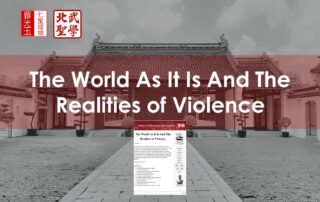
This article examines the ecological and relational realities of interpersonal violence in contemporary society. Drawing on empirical data, typologies, and conceptual analysis, it argues that violence is not episodic but a patterned and persistent feature of everyday life. It distinguishes violence from force, conflict, and aggression, then explores social contexts—family, peers, public spaces, and institutions—that shape vulnerability. A typology is presented by relationship and type of harm, supplemented by classifications of proactive versus reactive and direct versus indirect violence. The key takeaway is that preparedness against violence is not only tactical but fundamentally conceptual: to defend well, one must first understand.
Enroll in Our Fall Semester Meditation And Qigong Classes
In a world of constant stress and distraction, mindfulness and meditation offer a way back to balance. At Northern Sage Kung Fu Academy, our classes combine the Eighteen Luohan Qigong (moving meditation) with seated breath meditation to strengthen the body, calm the mind, and reconnect with your authentic self. Discover the physical, mental, and emotional benefits of this timeless practice.

Shanghai Summer 2025: City Life, Family Ties, and the Kung Fu Path
My time in Shanghai this summer has gone by quickly, as it always does. Each visit is both meaningful and productive, but more than that, this city never fails to leave me inspired and reinvigorated as I prepare to return to Canada. Follow Nathan's recap here.
Historical Context Of Seven Star Praying Mantis Kung Fu In The Late Qing Dynasty And Republican Era
Part I of this article explores the contextual backdrop in which Seven Star Praying Mantis Kung Fu emerged amidst political collapse, foreign incursion, and communal insecurity in Shandong from 1794 to 1949. It traces how rebellion, rural militarization, and warlordism shaped martial traditions as tools of defense and transmission. Grounded in historical analysis, the study highlights how martial arts were forged in adaptation and resistance. Part II will examine Luo Guang Yu’s pivotal role in preserving the tradition through the Shanghai Jingwu Athletic Association.