Knowledge Centre
The Natural Foundations of Moral Principles
Introduction
Moral principles emerge from life as it is lived. They are the distilled memory of living well under constraint—patterns of conduct that preserve viability, sustain integrity, and secure coherence across changing conditions. This essay develops a naturalistic account of principles as durable orientations that emerge from evaluative engagement with the world: we learn, through feedback, which actions stabilize trust, coordination, and mutual regard, and we refine those lessons into guidance that travels with us from one situation to the next.
The central claim is straightforward: moral principles are neither private preferences nor metaphysical properties. They are reflective condensations of evaluative facts—empirical, relational patterns that reveal how behavior affects the conditions of life together. Because these patterns can be observed, tested, and revised, they carry normative force without appealing to intuitionism or decree. Principles earn their authority by reliably indicating what preserves human flourishing in context.
This orientation is enactive: evaluation begins in the organism’s ongoing regulation of itself within a changing environment and matures, in human beings, into reflective appraisal and reason-giving. What is first sensed as improvement or breakdown in the fabric of relation becomes, over time, an articulated orientation for action. On this view, the familiar gap between “is” and “ought” narrows: moral guidance arises from stable regularities in how actions sustain or erode the goods upon which agency depends.
The argument proceeds in four steps. Section 2.1 clarifies what moral principles are: enduring orientations that organize perception, deliberation, and action. Section 2.2 grounds their genesis in the enactive intelligence of living systems—showing how regulation, prediction, and learning seed normative awareness. Section 2.3 specifies the relational nature of evaluative facts and explains why their empirical status underwrites normativity. Section 2.4 sets out the functional role of principles—how they regulate choice, integrate understanding, coordinate action, and discipline prediction—before 2.5 turns to limitations, showing how principles can drift from experience and why they must remain answerable to consequence.
Two commitments guide the analysis. First, moral reasoning must remain accountable to lived reality: principles retain legitimacy only when they track the evaluative facts that first disclosed them. Second, moral life is layered: the same patterns that protect individual agency also scale—carefully—to families, communities, institutions, and ecologies. The task is to keep orientation stable without letting it harden into rule.
Taken together, these claims present a disciplined, empirically anchored view of moral principles: not constraints upon freedom, but the intelligible forms through which freedom stays faithful to what makes a human life—and a shared life—endure.
To continue reading this flagship publication follow the download link → here.
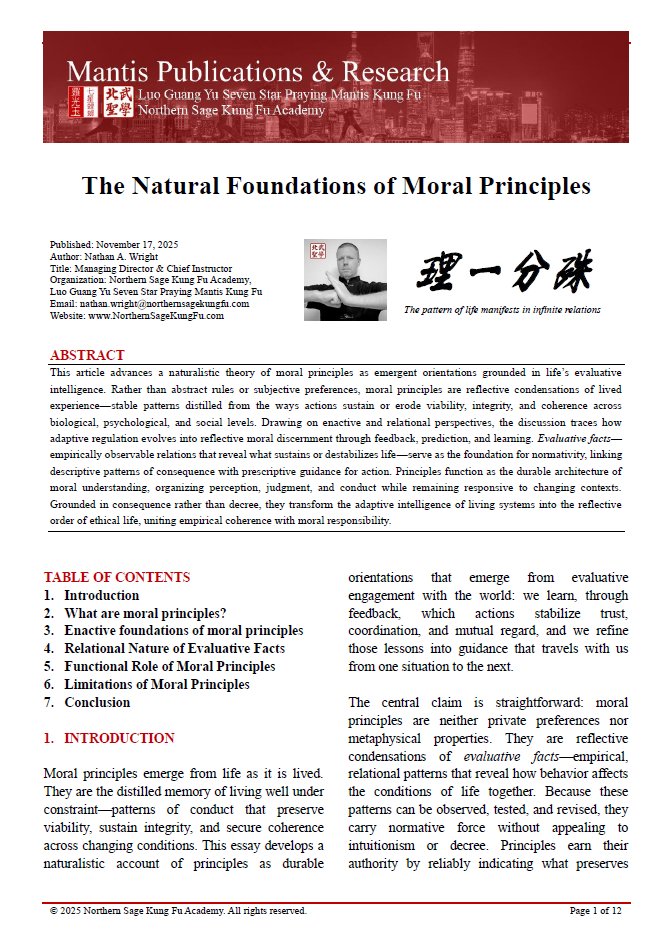
Click on the image above to download.
About The Author

Nathan is the Managing Director and Chief Instructor at Northern Sage Kung Fu Academy, and Chief Representative of Luo Guang Yu Seven Star Praying Mantis in Canada and China. With over 25 years of experience living in China, he is deeply committed to passing on traditional martial arts in its most sincere form. As part of his passion Nathan regularly writes on related topics of self-defense, combat, health, philosophy, ethics, personal cultivation, and leadership.
Other Articles