Knowledge Centre
Defence as a Condition of Autonomy: The Natural Foundations of Human Self-Regulation and Defence
Executive Summary
This article examines the conditions under which autonomy remains viable in environments structured by disruption, coercion, and interference. Human beings, like all living systems, persist only by preserving the integrity of their self-regulatory organization under pressure. The capacity to resist destabilizing forces is therefore not incidental to autonomy but central to its continued existence.
The central claim advanced here is that defence is a constitutive condition of autonomy rather than a secondary moral permission or legal exception. Across biological, cognitive, and human domains, autonomous systems persist only by preserving the organization of self-regulation under conditions of threat. Defence functions as the mechanism through which autonomy remains viable in adversarial environments.
Beginning at the biological level, the article traces defence as an evolutionarily conserved capacity for maintaining viability when avoidance and escape are insufficient. Cellular repair, immune responses, metabolic regulation, and neural prediction exemplify defensive regulation oriented toward preserving organizational coherence. Defensive aggression emerges within this framework as a cost-sensitive, context-dependent response that stabilizes self-maintenance rather than as pathological behavior.
Natural autonomy is presented as environment-coupled self-regulation sustained by natural defence. When interference alters regulatory trajectories or degrades viability, defensive capacities restore functional organization. Autonomy therefore depends structurally on the ability to resist destabilizing pressures.
Human autonomy elaborates these dynamics through predictive control, temporal depth, and cultural scaffolding. Coercion is defined as viability-degrading interference that disrupts the conditions of reflective agency. Human defence preserves the preconditions of moral agency itself by maintaining the integrity of self-regulation under coercive constraint.
The central implication is that self-defence precedes moral doctrine and legal justification. Law and ethics formalize an already existing biological and agential necessity: the protection of autonomous regulation under threat. Defence is not justified because it is morally permitted; it is morally intelligible because it is structurally required for agency to exist.
Download full pdf publication here.
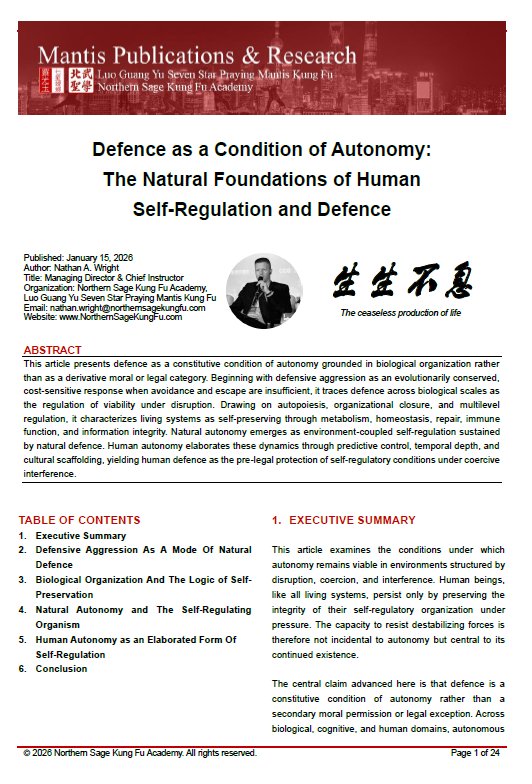
Click on file image above to download.
About The Author

Nathan is the Managing Director and Chief Instructor at Northern Sage Kung Fu Academy, and Chief Representative of Luo Guang Yu Seven Star Praying Mantis in Canada and China. With over 25 years of experience living in China, he is deeply committed to passing on traditional martial arts in its most sincere form. As part of his passion Nathan regularly writes on related topics of self-defense, combat, health, philosophy, ethics, personal cultivation, and leadership.
Other Articles