Knowledge Centre
Conceptual Definition and Framing of Violence
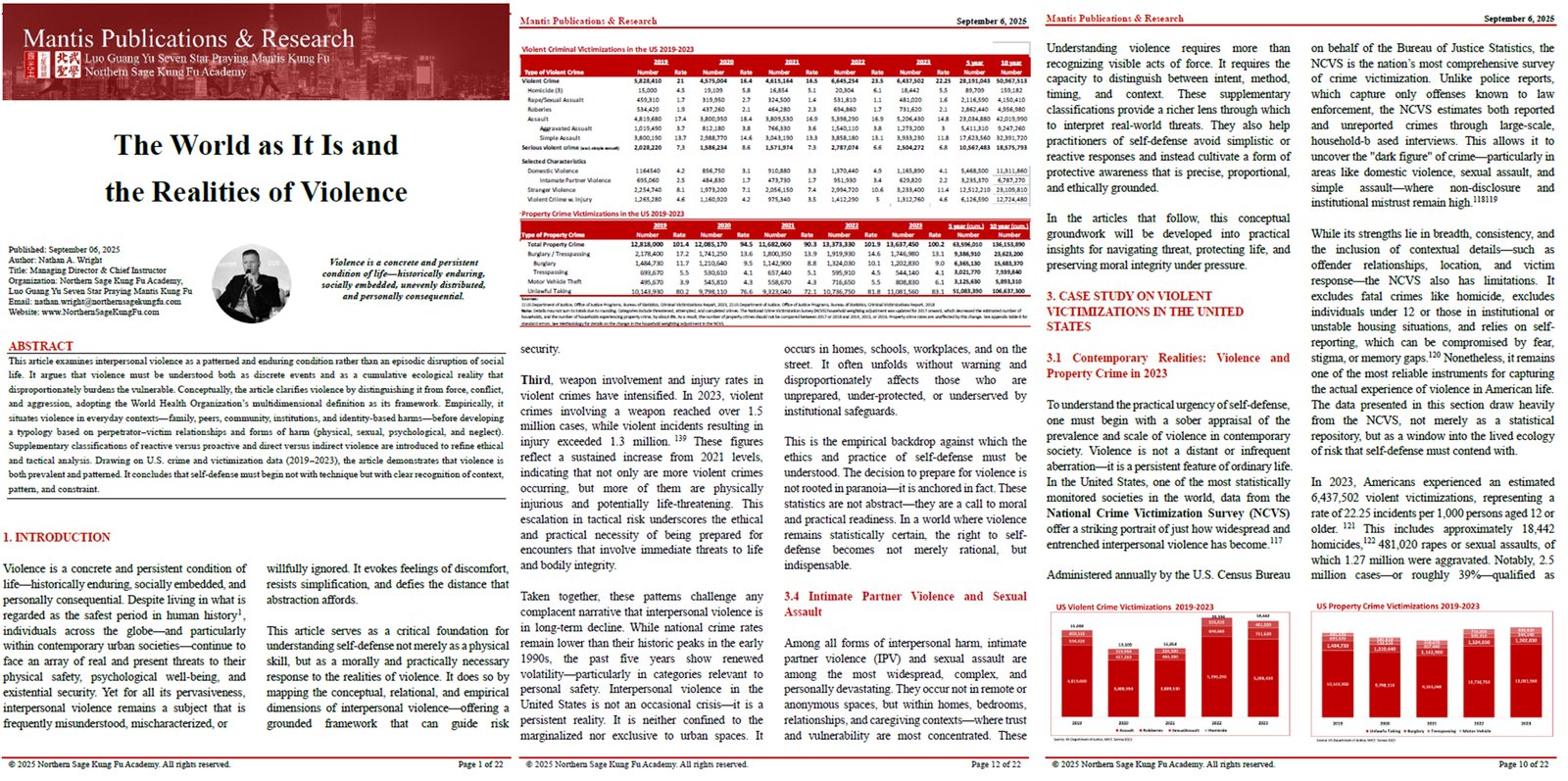
This article is a short excerpt from our flagship report on violence, The World as It Is and the Realities of Violence.
You can link to it here.
Conceptual Definition and Framing of Violence
Before we can ethically and legally assess the risk of violence or respond to it through justified self-defense, we must begin with a clear operational definition of what violence is. Contrary to popular belief about personal intuition, emotion, or cultural assumption—it requires conceptual precision. Without such clarity, it becomes impossible to distinguish reasonable and legitimate threat from perceived offense, or protective action from excessive force.
Working definition
A widely accepted and rigorous starting point is the definition provided by the World Health Organization (WHO): “Violence is the intentional use of physical force or power, threatened or actual, against oneself, another person, or a group or community, that either results in or has a high likelihood of resulting in injury, death, psychological harm, maldevelopment, or deprivation.”[1][2]
Significance
This definition is significant for its breadth, depth, and applicability across fields such as public health, criminal justice, ethics, and interpersonal defense.[3] It effectively extends the concept of violence well beyond immediate physical harm to include future long-term developmental disruption, psychological trauma, and material deprivation.[4] It also does two crucial things: it emphasizes intentionality,[5][6][7] and it recognizes potentiality. Violence, in this framework, includes not only the execution of harm but also the credible threat of it.[8]
Important implications
i) Violence Is Not Limited to Physical Acts
The phrase “use of power” expands the scope of violence beyond physical force. It includes institutional, relational, or economic mechanisms of domination that intentionally coerce, intimidate, or harm.[9] In this sense, violence may take the form of unjust detention, deprivation of care, economic marginalization, or the exploitation of vulnerability[10].
ii) Harm Is Multidimensional
Violence can result in more than just bodily injury although to be clear this is central. Additionally, it also encompasses psychological destabilization, disruption of cognitive or emotional development, social exclusion, and the denial of fundamental needs. Harm may be acute or chronic, visible or hidden, immediate or delayed.[11][12]
iii) Threat Is Also Violence
The threat of force—if credible and coercive—is itself also a form of violence. Threats can produce fear, loss of agency, and lasting psychological damage even if no physical act follows.[13] This is particularly relevant for ethical and tactical self-defense, where imminent threat may justify preemptive or protective action[14].
iv) Violence Can Be Immediate or Enduring
While violence is often understood as a direct and observable act—such as a physical assault—it can also unfold in enduring forms that cause harm over time. These may include long-term neglect, the intentional withholding of essential care, or the sustained use of coercion to control another person’s choices, movements, or opportunities.[15]
In such cases, the harm may not be confined to a single event, but instead, can results from repeated actions or omissions that predictably compromise a person’s well-being, safety, or ability to function. What unites both immediate and enduring forms of violence is the concept of deliberate intent[16]—the purposeful imposition or threat of harm that violates the conditions necessary for physical, psychological, or developmental integrity.[17]
v) Violence Is Often Normalized or Misrecognized
Violence does not always appear as an extraordinary rupture. It may be routinized within domestic life, legitimated by cultural norms, or hidden behind the façade of bureaucratic policy.[18] Recognizing this is critical: violence is not only what shocks—it is also what erodes.
Why is this important?
Understanding violence as intentional, multidimensional, and contextual is foundational to any meaningful response—whether ethical, legal, or tactical. It allows us to distinguish violence from related concepts such as conflict, force, or aggression. Not all force is violent (e.g., lawful restraint), and not all aggression leads to violence (e.g., hostile speech).[19] Violence, as defined here, refers specifically to the intentional imposition or threat of harm that diminishes physical integrity, psychological well-being, or existential security.
In future studies that follow, this conceptual framework will inform our approach to categorizing violence, analyzing its social and relational contexts, and identifying the specific risks to which persons—and their rights—are exposed. Only from such a foundation can ethical self-defense be responsibly developed.
→ Discover more insights and resources in our Knowledge Centre.
About the Author

Nathan A. Wright
Nathan is the Managing Director and Chief Instructor at Northern Sage Kung Fu Academy, and Chief Representative of Luo Guang Yu Seven Star Praying Mantis in Canada and China. With over 25 years of experience living in China, he is deeply committed to passing on traditional martial arts in its most sincere form. As part of his passion Nathan regularly writes on related topics of self-defense, combat, health, philosophy, ethics, personal cultivation, and leadership.
Endnotes
[1] World Health Organization. World Report on Violence and Health. Edited by Etienne G. Krug, Linda L. Dahlberg, James A. Mercy, Anthony B. Zwi, and Rafael Lozano. Geneva: WHO, 2002, 30.
https://www.who.int/publications/i/item/world-report-on-violence-and-health.
[2] World Health Organization. Violence: A Public Health Priority. Geneva: WHO, 1996. WHO/EHA/SPI.POA.2.
[3] Moore, Mark H. “Public Health and Criminal Justice Approaches to Prevention.” In Understanding and Preventing Violence: Volume 4, Consequences and Control, edited by Jeffrey A. Roth and Albert J. Reiss Jr., 1–20. Washington, DC: National Academy Press, 1995, 3-6.
[4] Rutherford, Andrew. “Violence: A Brief Cultural and Conceptual History.” In The Oxford Handbook of Criminology, edited by Mike Maguire, Rod Morgan, and Robert Reiner, 2–23. Oxford: Oxford University Press, 2007.
[5] World Health Organization. “Violence Prevention Alliance: Definition and Typology of Violence.” WHO, 2024. https://www.who.int/violenceprevention/approach/definition/en
[6] WHO, World Report on Violence and Health, 30.
[7] Walters, Richard H., and Ross D. Parke. “Social Motivation, Dependency, and Susceptibility to Social Influence.” In Advances in Experimental Social Psychology, Vol. 1, edited by Leonard Berkowitz, 231–276. New York: Academic Press, 1964.
[8] Anderson, Craig A., and Brad J. Bushman. “Human Aggression.” Annual Review of Psychology 53 (2002): 27–51.
[9] Stark, Evan. Coercive Control: How Men Entrap Women in Personal Life. Oxford: Oxford University Press, 2007.
[10] World Health Organization. World Report on Violence and Health. Geneva: World Health Organization, 2002, 30.
[11] Centers for Disease Control and Prevention (CDC). “Preventing Adverse Childhood Experiences (ACEs): Leveraging the Best Available Evidence.” Atlanta, GA: CDC, 2019.
[12] Moore, “Public Health and Criminal Justice Approaches,” 6-7.
[13] Centers for Disease Control and Prevention (CDC). “Child Abuse and Neglect Prevention.” Last modified 2024. https://www.cdc.gov/violenceprevention/childabuseandneglect
[14] Criminal Code, R.S.C. 1985, c. C-46, s.34. Government of Canada.
[15] R v Khill, 2021 SCC 37, [2021] 2 SCR 237
[16] Garner, Bryan A., ed. Black’s Law Dictionary. 11th ed. St. Paul, MN: Thomson Reuters, 2019.
[17] World Health Organization. “Elder Abuse.” Fact Sheet, 2022. https://www.who.int/news-room/fact-sheets/detail/elder-abuse.
[18] Galtung, Johan. “Cultural Violence.” Journal of Peace Research 27, no. 3 (1990): 291–305.
[19] Farmer, Paul. “An Anthropology of Structural Violence.” Current Anthropology 45, no. 3 (2004): 305–325.
Other Articles