Knowledge Centre
Character Building as a Core Element in the Praying Mantis Kung Fu Tradition
Core Element #3: Character Building and Ruist (Confucian) Philosophy
Martial tradition in Seven Star Praying Mantis Kung Fu is not only about developing combative skill; it is equally about the cultivation of moral character and practical wisdom. A key element of this tradition is rooted in classical Confucian thought (Ru Xue, 儒學), extending back more than 2,500 years, and further refined in Neo-Confucianism (Dao Xue, 道學) dating back almost 1,000 years. Grounded in the ideal of the junzi (君子)—the exemplary person—it emphasizes self-learning, personal cultivation, character development, moral responsibility, social engagement, and leadership.
Ruism assumes a naturalistic and deeply relational understanding of the world, positioning humans as differentiated moral agents embedded within an interdependent web of family, society, and the broader ecology of life. It teaches that human nature is inclined toward goodness, but this potential must be intentionally realized through sustained and cumulative effort. Within this tradition, martial practice is never isolated from life; it both expresses and tests one’s character. Competence in skill, influence, and power without virtue is deemed dangerous, while virtue without disciplined method is regarded as fragile. The task, therefore, is to unite both in the practice of leadership.
Drawing on the ancient canonical texts of the Four Books and Five Classics, the Ruist tradition identifies the five constant virtues (五常, wu chang)—ren 仁 (compassion), li 禮 (ritual conduct), yi 義 (rightness), zhi 智 (wisdom), and xin 信 (trust)—to be embodied in both attitude and praxis. In Seven Star Praying Mantis Kung Fu, these are further synthesized as martial virtue (武德, wu de), expressed through five external virtues of conduct and five internal virtues of mind. More specifically within the Luo Guang Yu lineage, these culminate in the ideal of San He Wu De (三合武德), the “Three Harmonies of Martial Virtue,” uniting a cultivated heart-mind with moral integrity and disciplined action. What follows below is a detailed typology of Ruist and martial virtue ethics.
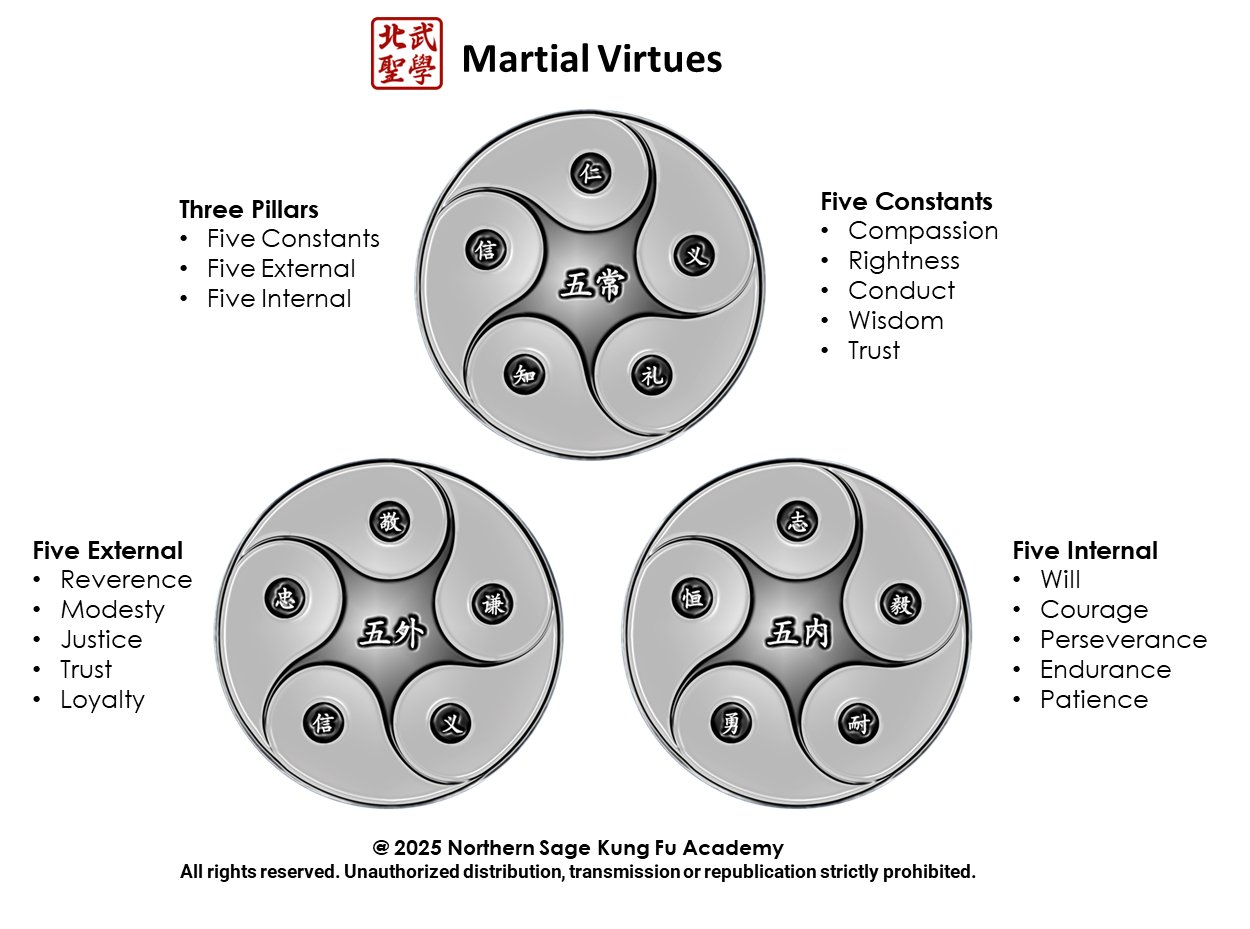
Amongst the Ruist virtues, Ren is the cornerstone. Often translated as humanity, compassion, benevolence, empathy, or kindness, Ren is an inner attitude that recognizes the dignity of others and acts not only to preserve life but also to promote shared well-being and the greater good. In partnership with Shu (reciprocity), Ren provides both a baseline and an ideal for moral conduct: in its negative form, it warns, “do not do unto others what you would not want done to yourself”; in its positive form, it encourages, “in establishing oneself, one should also seek to establish others; in enlarging oneself, one should also seek to enlarge others.” Both forms direct moral life toward the highest individual and social good.
Ren grows out of real, lived relationships. It begins in the family and is grounded in Xiao (孝), or family reverence, which carries obligations of respect, care, and loyalty toward parents. The family is more than just another social group; it has sacred meaning as the first training ground where individuals connect with others through care, love, and guidance. From childhood to adulthood, it shapes moral feelings and habits. From this foundation, moral concern naturally extends outward in widening circles—to kin, community, nation, and eventually to all humanity. In this way, Ren is not a vague humanitarian idea but a cultivated way of thinking, feeling, and acting, rooted in experience and guided by mutual responsibilities.
This ethical core has been preserved across generations as a lived tradition of praxis. Within the Luo Guang Yu lineage, masters have consistently emphasized that technical excellence and moral formation are inseparable: skill must be guided by virtue, and virtue refined through disciplined practice. In this way, Ruist philosophy elevates Seven Star Praying Mantis Kung Fu beyond a system of combat or health cultivation—it becomes a way of life and a lifelong discipline of character building, where mastery is measured as much by who one is as by what one can do.
Contact us to enquire more about our combative, meditative and philosophical practices.
About The Author
Nathan A. Wright
Nathan is the Managing Director and Chief Instructor at Northern Sage Kung Fu Academy, and Chief Representative of Luo Guang Yu Seven Star Praying Mantis in Canada and China. With over 25 years of experience living in China, he is deeply committed to passing on traditional martial arts in its most sincere form. As part of his passion Nathan regularly writes on related topics of self-defense, combat, health, philosophy, ethics, personal cultivation, and leadership. Email Nathan if you have questions on this article, or if you have interest in learning more about studying traditional Seven Star Praying Mantis Kung Fu.
Related Articles
→ Current State of Praying Mantis Kung Fu (Sept. 2025)
→ What Is Tradition?
→ What Is a Martial Tradition?
→ Combat as a Core Element of the Praying Mantis Tradition (Sep. 2025)
→ Longevity as a Core Element of the Praying Mantis Tradition
→ Character Building as a Core Element of the Praying Mantis Tradition
→ The Meaning of Lineage and Transmission
→ The Living Unity of Tradition in Praying Mantis Kung Fu
→ Reflections on Tradition and Return to Meaning in Martial Practice (Aug. 2025)
→ More from our Knowledge Centre
Other Articles