Knowledge Centre
Qigong & Longevity as a Core Element in the Praying Mantis Kung Fu Tradition
Core Element Two: Qigong and the Cultivation of Energy and Mind
Within the Seven Star Praying Mantis tradition, the cultivation of health, vitality, and mental clarity is not an optional supplement to combat training but a foundational pillar. A living martial tradition must sustain the practitioner over decades of practice, enabling both technical refinement and the transmission of knowledge to the next generation. In this respect, the tradition preserves an integrated system of mind–body cultivation through the Eighteen Luohan Xing Gong (十八羅漢行功), a dynamic energy qigong set designed to strengthen the body, improve health, vitalize energy, and regulate the mind.
Historically, the Luohan Xing Gong is attributed in martial folklore to Bodhidharma (達摩, Damo), the Indian monk credited with transmitting Chan Buddhism to China during the Northern Wei period (471–534 CE). Other exercises also attributed to Bodhidharma include the Muscle-Tendon Classics and the Bone-Marrow Washing Classics. While historical sources such as Yang Xuanzhi’s Memories of Luoyang’s Temples offer only sparse and indirect reference to Bodhidharma, legend holds that he introduced these exercises at the Shaolin Temple in modern day Henan province to improve the health and endurance of monks engaged in long hours of seated meditation and, over time, martial training. In this original context, the movements served a unifying purpose: restoring physical vitality after prolonged stillness, developing structural integration, cultivating breath control, and focusing intent—qualities that carried over from seated meditation and proved equally valuable in martial application.
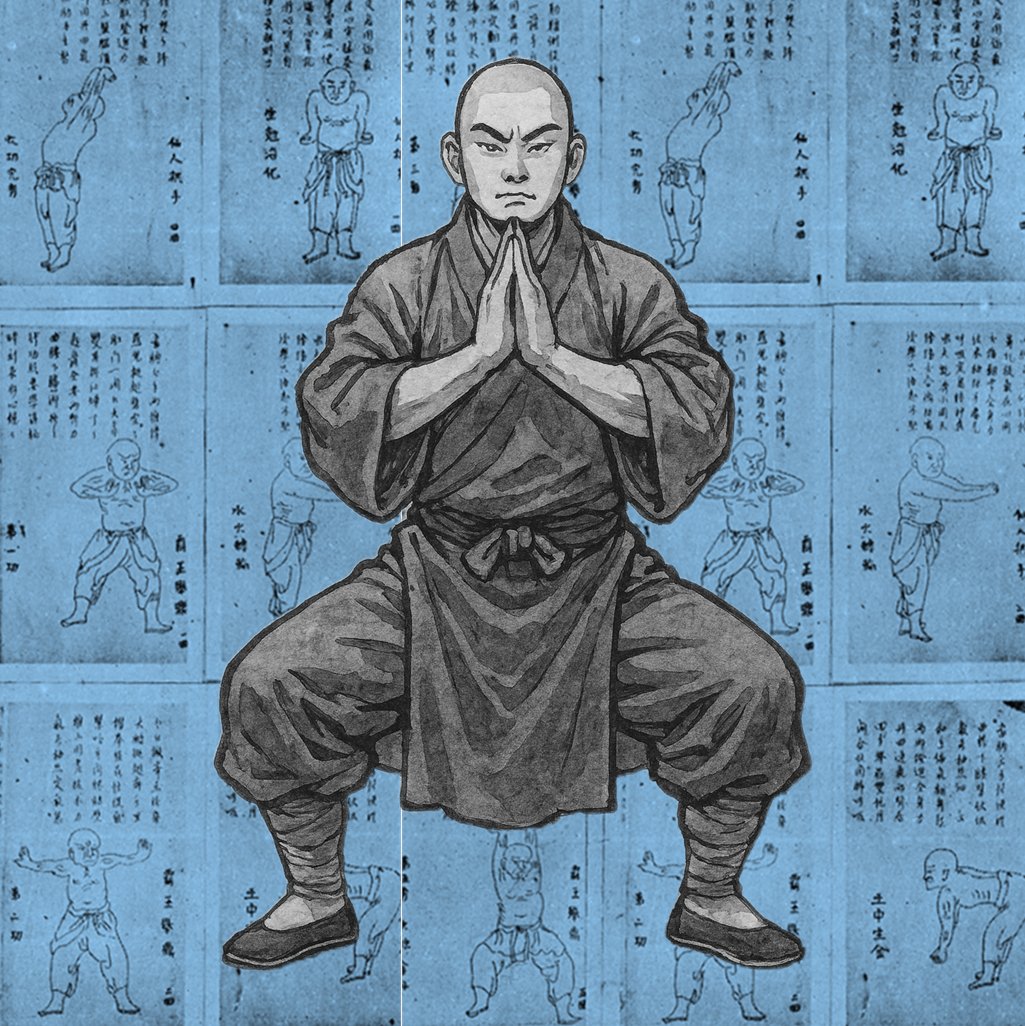
The Eighteen Luohan Xing Gong as preserved in Seven Star Praying Mantis Kung Fu was documented by Master Fan Xu Dong (樊旭東, c. 1841) in his Shaolin Yi Bo Zhen Zhuan (少林衣鉢真傳) and transmitted to his disciples, including Master Luo Guang Yu. Within the taxonomy of Chinese internal arts, it is classified as an external moving qigong practice (wai gong, 外功; xing gong, 行功) and more specifically wai dan (外丹), in contrast to nei dan (內丹). The set consists of seventy-two sequential postures that combine coordinated movement, regulated breathing, and directed intention. The practice systematically mobilizes the joints, massages the internal organs, improves circulation, activates the parasympathetic nervous system, and builds energy (qi) in specific regions of the body before circulating it through the twelve primary meridians. Physiologically, this develops flexibility, balance, and resilience; mentally, it cultivates tranquility and heightened proprioceptive awareness.
Beyond its immediate effects on mobility and circulation, the Eighteen Lohan Qigong produces a cascade of adaptive physiological responses that progressively strengthen the body’s integrated systems. The deep, diaphragmatic breathing patterns enhance oxygen uptake and carbon dioxide exchange, increasing blood oxygenation and improving overall metabolic efficiency. The controlled, full-range movements condition both slow- and fast-twitch muscle fibers, promoting elastic strength in the tendons and fascia while maintaining joint lubrication and synovial health. Gentle torsional movements stimulate lymphatic drainage, aiding detoxification and immune function. The rhythmic expansion and contraction of the abdomen and thorax gently massage the liver, kidneys, and digestive organs, supporting hormonal balance and internal regulation. Over consistent practice, these processes recalibrate posture, stabilize the spine, and optimize nervous system communication between the brain and periphery—resulting in a body that is not only stronger and more flexible but also more energetically efficient and resistant to fatigue.
The mental and cognitive effects of the Eighteen Lohan Qigong arise from the union of mindful attention, rhythmic breathing, and embodied awareness cultivated throughout the practice. The deliberate pace and sustained focus calm the sympathetic “fight or flight” response, reducing stress hormones and promoting a state of relaxed alertness. As attention anchors in the coordination of breath and movement, practitioners develop heightened interoceptive and proprioceptive awareness—the ability to sense internal bodily states and spatial orientation with precision. This refined awareness strengthens the neural pathways between body and mind, improving concentration, emotional regulation, and cognitive flexibility. Regular practice has been shown to enhance memory, reaction time, and decision-making by stabilizing brain wave coherence and optimizing oxygen flow to the cerebral cortex. Psychologically, the set fosters patience, equanimity, and resilience, balancing mental clarity with emotional steadiness—a cultivated calm that naturally extends into daily life and martial training alike.
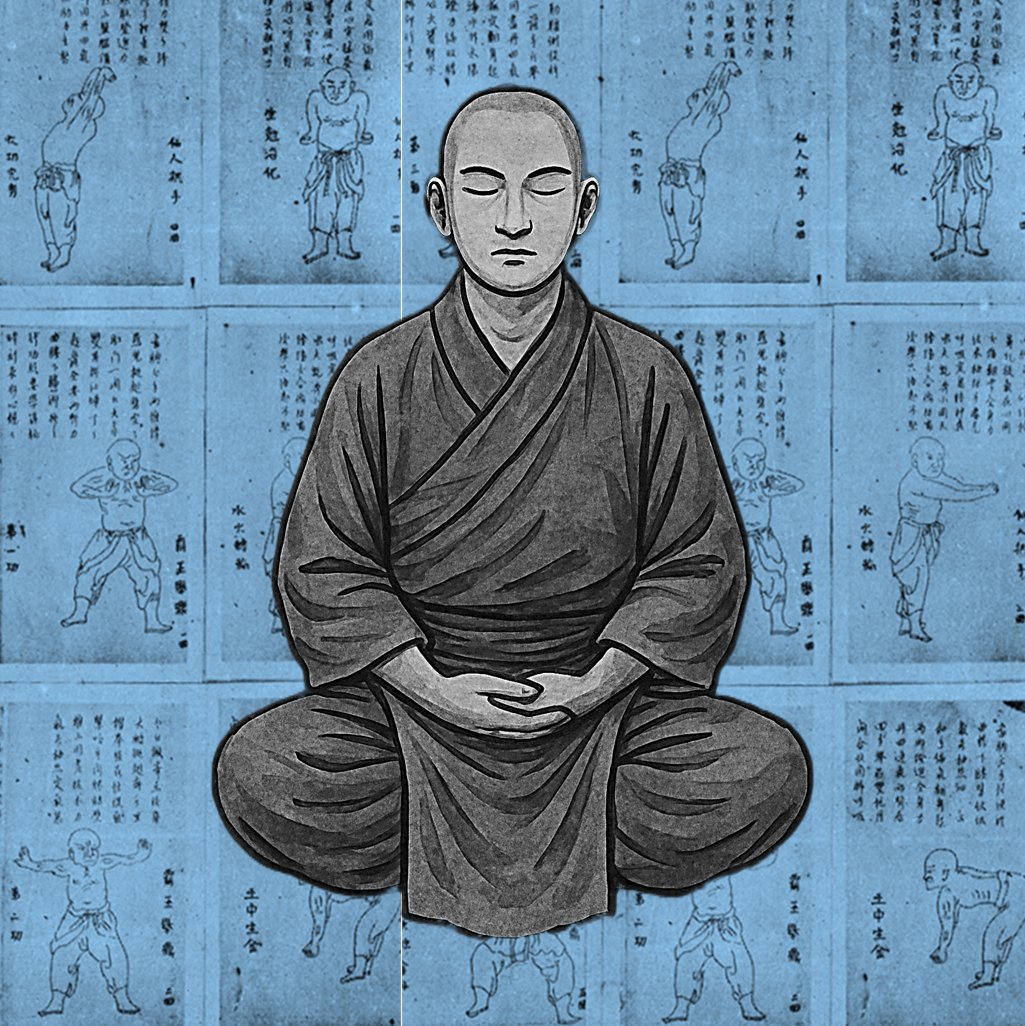
When practiced alongside seated meditation, the Eighteen Lohan Qigong serves as both preparation and complement to deeper internal cultivation. Through its systematic sequence of postures, breathing, and intent, the practice builds and strengthens the flow of qi energy throughout the meridian system, awakening vitality in the limbs and core while stabilizing the breath and nervous system. This dynamic conditioning effectively gears the body for the next phase of seated meditation by clearing obstructions and harmonizing the channels through which qi will later circulate in stillness. During meditation, this refined energy is guided through the Small Circulation (xiǎo zhōu tiān), linking the Governor and Conception vessels in a continuous loop that integrates respiration and awareness. With sustained practice, the energy expands into the Great Circulation (dà zhōu tiān), synchronizing the entire meridian network into a unified flow. This interplay—movement cultivating flow, stillness refining essence—creates profound physiological and cognitive synergy. The body achieves systemic balance, the breath deepens naturally, and the mind settles into tranquil clarity. In this unity of dynamic and meditative practice, vitality, strength, and serenity become one seamless process of self-cultivation within the Lohan tradition.
The theoretical underpinnings of this qigong system are deeply interwoven with the principles of Traditional Chinese Medicine (TCM), which predates Bodhidharma’s legendary arrival by centuries. The cultivation of jing (精, physical essence), qi (氣, vital energy), and shen (神, spirit) is a long-standing tradition discussed extensively in the Huangdi Neijing (黃帝內經, c. 168 BCE), the foundational text of TCM. Within Seven Star Praying Mantis Kung Fu, this tripartite model is applied pragmatically: jing as the physical structural foundation, qi as the dynamic energetic force of movement, and shen as the unifying heart–mind awareness guiding intention and action. The regular practice of Luohan Xing Gong is thus not merely a health exercise but an embodied expression of these interrelated principles, sustaining the vitality of both the practitioner and the tradition itself. Master Luo Guang Yu integrated this model conceptually into the naming of the three levels of training in Seven Star Praying Mantis Kung Fu—Jing, Qi, and Li.
The benefits of this training extend well beyond general health. Increased joint mobility and connective tissue elasticity reduce the risk of injury during dynamic combat, while refined breath regulation enhances endurance and sustains energy output under pressure. Heightened mental control sharpens focus, improves decision-making, and stabilizes emotional response in high-stress situations. Integrated posture and coordinated alignment reinforce structural stability and power generation, translating internal coherence into external effectiveness. In this way, the Luohan Xing Gong directly supports the combative dimension of Seven Star Praying Mantis Kung Fu—functioning not as a parallel or ornamental practice, but as a true partner discipline that deepens strength, resilience, and precision in every movement.
Contact us to enquire about training.
About The Author
Nathan A. Wright
Nathan is the Managing Director and Chief Instructor at Northern Sage Kung Fu Academy, and Chief Representative of Luo Guang Yu Seven Star Praying Mantis in Canada and China. With over 25 years of experience living in China, he is deeply committed to passing on traditional martial arts in its most sincere form. As part of his passion Nathan regularly writes on related topics of self-defense, combat, health, philosophy, ethics, personal cultivation, and leadership. Email Nathan if you have questions on this article, or if you have interest in learning more about studying traditional Seven Star Praying Mantis Kung Fu.
Related Articles
→ Current State of Praying Mantis Kung Fu (Sept. 2025)
→ What Is Tradition?
→ What Is a Martial Tradition?
→ Combat as a Core Element of the Praying Mantis Tradition (Sep. 2025)
→ Longevity as a Core Element of the Praying Mantis Tradition
→ Character Building as a Core Element of the Praying Mantis Tradition
→ The Meaning of Lineage and Transmission
→ The Living Unity of Tradition in Praying Mantis Kung Fu
→ Reflections on Tradition and Return to Meaning in Martial Practice (Aug. 2025)
→ More from our Knowledge Centre
Other Articles